Build the Future Together’s founder Merritt David Farren is an active participant in the ongoing State Farm Insurance Rate Proceedings – Representing the Interests of all California Consumers in the Proceedings.
Under California law, insurance companies that want approval from the California Department of Insurance for a major rate hike, need to show their need for the rate hike in a judicial proceedings.
State Farm has asked for a major rate hike and is currently attempting to demonstrate in need in a judicial proceeding before Administrative Judge Karl Frederic Seligman.
California law also allows citizens to seek to participate to represent consumer interests in the judicial proceedings.
Build the Future Together’s founder, Merritt David Farren, has been admitted as one of the four parties in the proceedings as a representative of consumer interests in the proceedings.
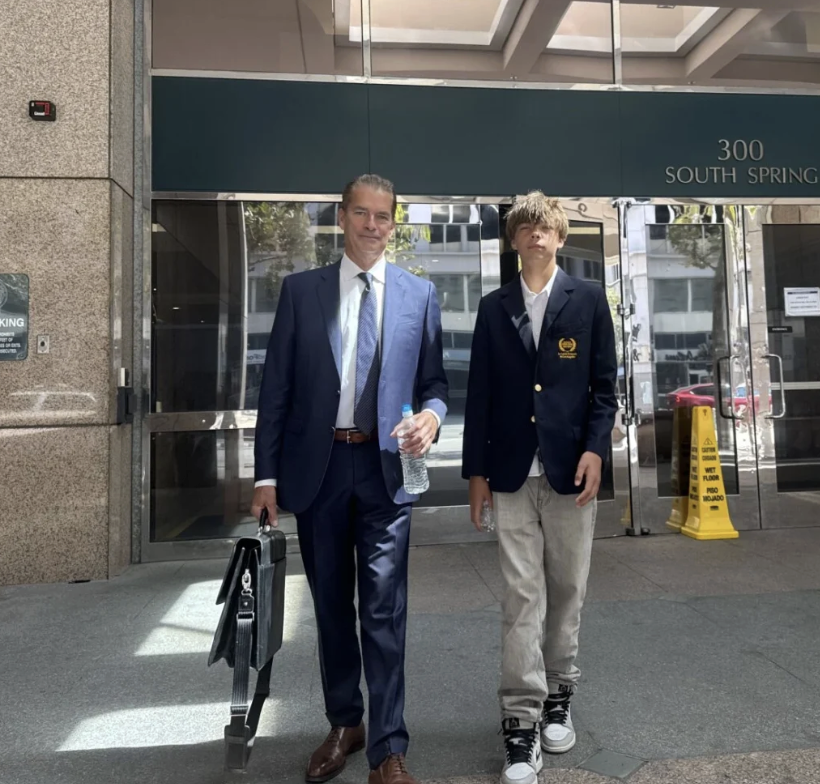
Merritt Farren leaves the Ronald Reagan State Building in downtown Los Angeles with his son after a State Farm rate-hike hearing.
Photo: JAMIE PAIGE
See Press Coverage
- Palisades Fire Survivor Merritt Farren Fights State Farm, Circling the News, August 29, 2025
- Disneyland’s Former Top Lawyer Leads Fight for Fair Insurance After Palisades Fire, Westside Current, May 31, 2025
- Ex-Disneyland, Audible Legal Chief Thrusts Himself Into Fracas Over State Farm’s Palisades Wildfire Response, Law.com, June 13, 2025
- Judge Rules Homeowner Can Probe State Farm Claims Practices, Los Angeles Times, August 29, 2025
From Merritt:
In the aftermath of the Palisades and Eaton fires a few things were evident to me from talking to friends and neighbors and following a multitude of WhatsApp group chats:
- People were suffering, as much from the day to day post fire challenges, big and small, as they were from their loss.
- Insurance was the biggest source of ongoing trauma. Some, who lost their homes and who had insurance from premium providers like Pure and Chub, were being supported and treated well. Others were being treated miserably.
- Those insured by State Farm and California Fair Plan were suffering most.
- They were being put through the ringer to detail and prove up personal effects they lost.
- They were forced to meet with incompetent adjusters and rebuild cost estimators sent in from out of state. Estimators who were unfamiliar with local building codes, local construction costs and local standards of taste and quality.
- They were given rebuild cost estimates that got basic facts wrong – like the number of square feet and the number of bathrooms in a house destroyed.
- Their adjusters changed multiple times, and each wanted yet another full explanation of the home and possessions lost – requiring a never ending reliving of something painful to think about even once.
- They were given ridiculously low rebuild cost estimates, causing stress and sleepless nights. I was told by a friend insured by Pure that Pure’s estimators were working up rebuild estimates for the Palisades in the range of $800 to $1,200 a square foot. State Farm was providing its customers with estimates as low as $275 a square foot – adequate for a garage perhaps, but not a home.
- And the distress of individuals and families became the community’s distress. Stress caused by miserable treatment by insurance companies tore families apart. Those with insurance from companies that treated them well wondered about rebuilding if their friends and neighbors, with insurance from State Farm weren’t able to do so.
- of Palisades fire victims has caused a massive delay in the rebuilding of the community, meaning that all in the community suffer.
Then State Farm, the insurance company that appeared to be treating its customers most poorly, asked the California Department of Insurance to approve a massive emergency state-wide rate hike.
Wait, what?
I can assure you that that didn’t sit well with State Farm insureds who had lost their homes in the Palisades and Eaton fires.
“How can they even ask to raise rates when they’re treating us so badly” was the first refrain on WhatsApp chats.
“And how can the Insurance Commissioner, Ricardo Lara, even think of considering State Farm’s rate increase request without requiring State Farm to behave well.” was the second refrain.
Upset State Farm insureds who lost their homes started calling the insurance commissioner’s office to urge the Department of Insurance to tie any rate increase to better treatment of those who had just lost their homes and all their possessions. What did they all here in response? “Rate increases have nothing to do with complaints.”
Really? That makes no sense, right?
Surely what customers get when they buy insurance needs to be tied directly the rate approved for the insurance, no?
How can it be otherwise?
After all, you can’t determine a fair or appropriate price for any “product” without knowing what the product is. The idea is absurd.
I called the Department of Insurance myself. A nice man who seemed sympathetic told me simply: No, sorry. That’s not “how it works”. “The Department of Insurance will be reviewing State Farm’s rate increase request without taking into consideration the treatment you and others are receiving.”
So I did some research, looking at the underlying law that had created the rate approval process. My conclusion, the underlying law requiring insurance companies operating in California to get approval before raising rates should be understood to require that claims handling practices be detailed as part of their rate approval requests. In other words, the Department of Insurance has been doing it wrong.
Yes, the approach the Department was taking in reviewing State Farm’s rate increase is the approach it has been using to consider other rate approval requests, but it was not the approach it should be taking.
The insurance community, no doubt, loves the fact that it can get approvals for rate increases without having to make any commitment whatsoever on the way they will treat consumers who buy the policies they get rate approvals for – but that’s an awful set-up for consumers.
Why has the California Department of Insurance approving rate increases in such a consumer unfriendly way? Hard to say. Maybe they just want to make things easy for themselves? Or maybe its all about the money the insurance industry pumps into the coffers of the politicians who control the state government?
There have been numerous articles detailing the seemingly cozy relationship between insurance industry executives and Ricardo Lara, California’s Insurance Commissioner, a Democrat elected to the position. Lara was put under investigation for unethical practices in the State of California due, among other things, to multiple trips to international conferences he certainly didn’t need to attend to which he flew first class. First class? With the citizens of California footing the bill? I and other executives at Amazon, a prosperous company, never flew first class. First class was considered a wasteful extravagance. Why would any state official ever be flying first class anywhere?
Time to Take Action
My research into the insurance rate approval process in California also revealed something I might use to help change the process. Proposition 103, the California voter approved initiative mandating approval of insurance company rate increases included a means by which private citizens can seek to intervene in the process to advocate for the interests of consumers. What’s more, intervention requests are made public by the Department of Insurance, meaning that if I were to request to intervene and include in my request a statement of how I’d like to see the process improved, my recommendation on how the process could be improved would become part of the public record, which in and of itself might help bring about positive change.
I filed my request to intervene in the State Farm rate approval proceedings on May 22, 2025. In my request, which you can see a copy of on the Department of Insurance website here, I did two things. First, I detailed a number of the egregious wrongs I saw State Farm committing in handling claims of those who lost their homes in the Palisades and Eaton fires. That ensured that the stories of those suffering would be part of the public record. Second, I asked that I be allowed to intervene in order to represent the interests of consumers and to make the argument that the rate approval process should include a definition of the key ways in which insurers handle claims.
In my filing, I analogized to what a rate approval process might look like for automobiles, if the State of California had a Commissioner of Automobiles who needed to approve the price at which cars were being sold. I said that if that commissioner made her or his decision without taking into account whether the car the price was being approved for was a Kia or a Tesla, everyone would say that was absurd. But that’s exactly what the Commissioner of Insurance is doing in rate approval proceedings.
I also emphasized that I had deep experience and expertise helping two of the world’s most customer centric companies balance the need for profitability with best in class customer service and care – and avowed a belief that my experience could be generally helpful to the interests of consumers in the rate approval proceedings.
My request to intervene was picked up by the judge hearing the State Farm rate increase request. Not all rate increase requests go to a judge, but those that request major rate hikes do, and the judge establishes a streamlined litigation process for the rate proceeding to be considered. The judge, Frederic Seligman, scheduled a hearing to allow me to present and argue my request to intervene and to let State Farm, the Department of Insurance and Consumer Watchdog, a consumer advocate already acting as an intervenor, make their arguments as to whether I should be allowed to intervene.
State Farm filed papers ahead of the hearing opposing my intervention, basically arguing “that’s not the way rate proceedings are handled.” Not surprising. The Department of Insurance filed papers opposing my intervention making the same argument. Not surprising, I suppose, in that I was asking them to take an approach they have never taken, but disappointing, nonetheless. How could a Department created to serve the interests of the citizens of the state, fight someone seeking to propose consumer friendly reform?
The day before the hearing on my petition to intervene, Ricard Lara, California’s Insurance Commissioner, elected to the post by the voters of the State, announced that he would open a market conduct inquiry to look into “complaints” he’d received regarding State Farm’s conduct. State Farm hurried out an electronically filed letter to the judge informing the judge of Lara’s announcement as a way of saying “Look your honor, the matters Farren is raising are already being dealt with over there. No need to include them here.” I suspect that the timing of Lara’s announcement of his market conduct review, if not the market conduct review itself, was driven by my hearing date.
The Hearing
The hearing, which took place by Zoom, included lively discussion about what I was looking to achieve. I started my comments by reminding the group that California is one of the world’s great centers of innovation, and calling on the group to lean into that spirit of innovation to innovate as required to get us out of the insurance crisis we are currently in.
I emphasized that my goal was not that State Farm’s practices be judged in the proceedings, but simply that they be noted. Having them noted would achieve two things. First it would help ensure that the cost data being used by State Farm to show that it needed a rate hike was accurate. State Farm’s costs are a direct function of its claims handling practices. If State Farm’s practices have changed over time, then historical cost data won’t be an accurate predictor of future costs. Second, once information on claims handling practices became part of the pubic record, it would be positioned to help consumers shopping for insurance make more informed decisions.
The Judge’s Decision
The judge’s decision, which he issued in a written holding a couple of weeks after the hearing, let me in. In his decision, the judge did an excellent, scholarly job laying out the legal basis supporting my request to intervene, and specifically refuted State Farm’s and the Insurance Department’s argument that what I stated should be included in the proceedings was not relevant to the proceedings. If the decision of the Department of Insurance and to oppose my intervention could cause me to question my faith in our governmental institutions, the judge’s well-reasoned, well written and scholarly decision restored my faith.
Subsequent Developments
By the time Judge Seligman put out his decision letting me intervene, the date for discovery in the proceedings had already passed. Discovery allows a party in a legal proceeding to request documents from other parties to establish facts relevant to the proceedings.
Given that, I needed to file a motion requesting that the date for discovery be extended so that I could request documents from State Farm. Not giving up, the Department of Insurance objected to my request. It also filed an alternate proposal, that I be allowed to look into State Farm’s practices in a separate bifurcated proceeding that would follow the rate setting proceeding. One interpretation of the Department’s alterative proposal: that it was a cynical way of attempting to boot me out of the proceedings that would eventually be followed by another effort by the Department to ensure the alternative proceeding they themselves proposed would never happen.
Fair? Not fair? Hard to know.
My motion, and Department’s alternative bifurcation proposal were then the subject of an in person hearing before the Judge in Los Angeles. At the hearing were members of the press, my son Sebastain and a number of State Farm customers who lost their homes in the recent fires.
In my opening comments in the hearing, I thanked the members of the press, my son, and those who lost their homes for being there.
In what for me was the most extraordinary moment in the hearing, the lawyer representing State Farm chose to start comments by admonishing me for grandstanding in thanking those who lost their homes for being there.
Wow. Who at State Farm writing its narrative? Who thinks it’s a good idea to criticize someone who has just acknowledged your customers and their extraordinary, painful loss? Wow.
Not surprisingly, all in, the Judge granted my motion to extend the discovery date and put aside the Department of Insurance’s alterative proposal.
The Events Since Being Granted a Discovery Date Extension
After the Judge extended the discovery date so that I could serve State Farm a discovery request, I sent my discovery request to State Farm and suggested to State Farm’s counsel that we discuss it. State Farm’s response: effectively, talk to the hand.
I was then forced to file a motion to compel State Farm to respond to my discovery request.
To that, State Farm objected, of course. Not giving up its own fight against my effort, the Department of Insurance also filed an objection. I suppose they get points for consistency.
Next up: more discovery back and forth and a trial, now scheduled to take place in January.
I’m in this for the long haul and have no plan to give up my fight for the interests of consumers in the proceedings.
Stay tuned.